

Amazon Web Services
Connect Amazon Web Services: authentication, permissions, what Noru collects, and troubleshooting.
- Authentication
- AWS IAM role (AssumeRole)
- Categories
- Infrastructure, Security
- Sync cadence
- Daily by default (hourly, weekly, or monthly on request)
- Requested access
arn:aws:iam::aws:policy/SecurityAuditsecurityhub:* read actions (22)sts:GetCallerIdentitys3:GetBucketTagging
Noru reads one AWS account by assuming an IAM role you create from a
CloudFormation template it generates. No AWS access keys are stored. The role
carries the SecurityAudit managed policy plus an inline read-only Security
Hub policy.
What Noru collects
| Evidence type | Evidence | Read from |
|---|---|---|
| Scan result | AWS Security Findings | Security Hub findings (up to 100), insights, enabled standards |
| Policy | IAM Users, Roles, Policies; IAM Access Keys | IAM list and get calls |
| Log | AWS CloudTrail Events | The 50 most recent CloudTrail events |
| Configuration | S3 Buckets, RDS Instances, Lambda Functions, IAM Password Policy, IAM Account Summary, EBS Default Encryption, CloudTrail Trails, Config Recorder Status, VPC Flow Log Coverage, Lambda Public Functions | S3, RDS, Lambda, IAM, EC2, CloudTrail, Config describe calls |
| Network | Load Balancers, Security Groups | ELBv2 and EC2 describe calls |
| Inventory | AWS Account Summary | STS and IAM |
Assets are created for EC2 instances, RDS instances, S3 buckets, Lambda functions, and VPCs. Findings come from Security Hub (resolved and suppressed skipped) plus derived checks: IAM users without MFA, root access keys, public RDS instances, security groups open to 0.0.0.0/0, publicly invokable Lambda functions, expired ACM certificates. Evidence maps to IAM, vulnerability, configuration, cryptography, network, and asset management controls.
What Noru does not collect
- Object contents in S3, database rows in RDS, or DynamoDB items.
- Secret values. Secrets Manager is limited to listing metadata.
- Lambda environment variables. They are never stored.
- KMS, GuardDuty, Secrets Manager, ACM, and DynamoDB data. These are not read
today, even though
SecurityAuditwould allow it.
CloudTrail events are stored
The 50 most recent CloudTrail events are collected as evidence, including their request parameters. If your trail records sensitive request bodies, turn off Include CloudTrail before connecting.
Before you connect
- Permission to create a CloudFormation stack that creates an IAM role in the target account.
- The AWS region where Security Hub is enabled.
- Admin or editor role in Noru.
Connect
noru-reader- followed by a per-integration token.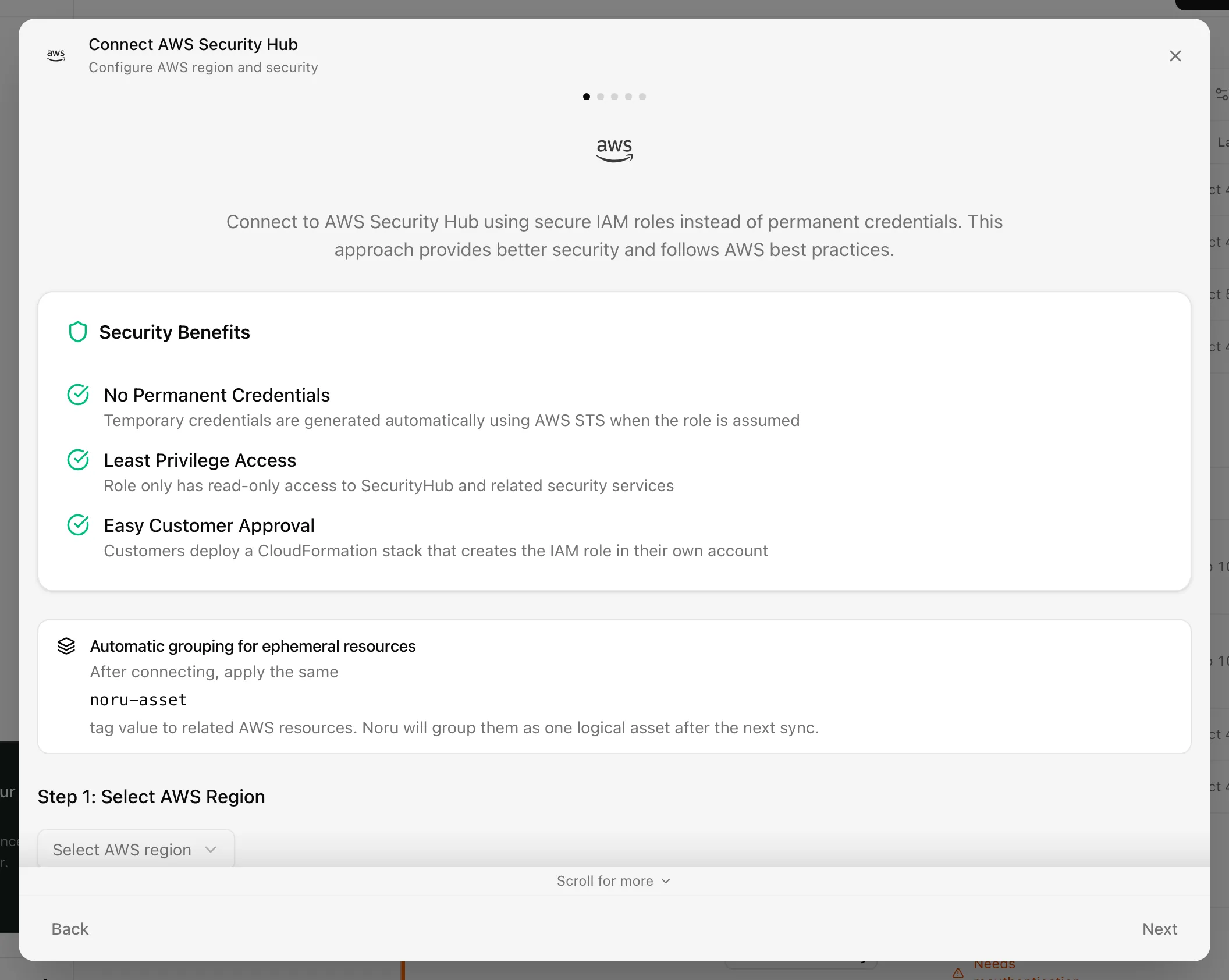
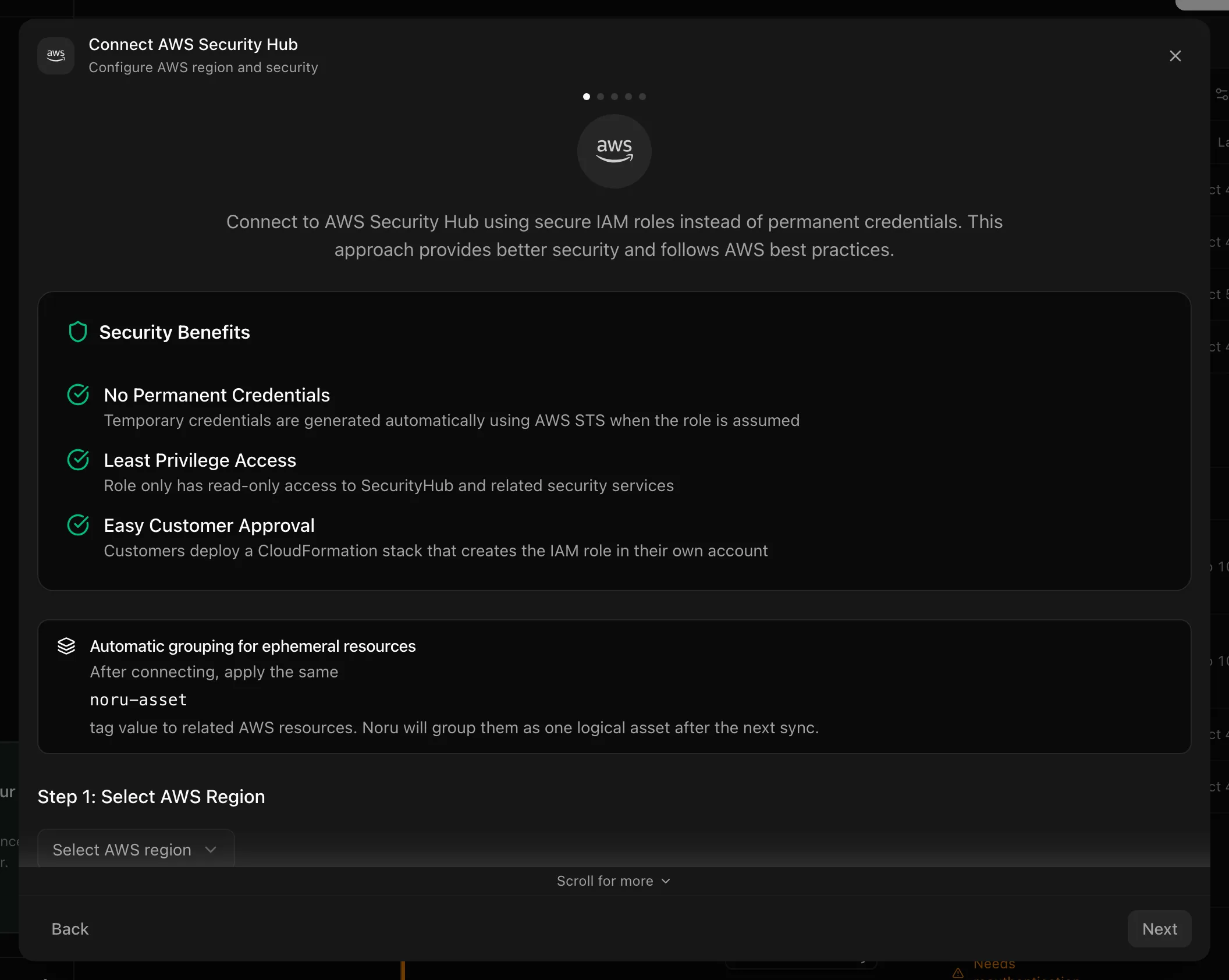
Choose your own Data source name. The example text is a placeholder, not a saved value. See Naming and using connection dialogs for naming, scrolling, and closing behavior.
After connecting
The first sync runs on schedule or when you click the row's refresh button. Expect evidence under the names above, assets in Assets, and findings in Findings. The dialog's Max Security Findings and Finding Severity options currently have no effect: every sync collects up to 100 findings regardless of severity.
Permissions in detail
| Grant | Why Noru needs it | What it could technically allow |
|---|---|---|
SecurityAudit managed policy | IAM, CloudTrail, Config, S3, EC2, RDS, Lambda, and ELB describe and list calls | Read access to configuration across most AWS services, including some Noru never calls |
Inline NoruSecurityHubReadOnlyPolicy (22 securityhub: actions such as GetFindings, GetInsights, GetEnabledStandards, DescribeStandards, ListMembers) | Security Hub findings and standards | Read every Security Hub finding and member account relationship |
sts:GetCallerIdentity | Verify the assumed role belongs to the stated account | Nothing beyond the caller's own identity |
s3:GetBucketTagging | Tags on buckets for inventory | Bucket tags only |
The trust policy lets Noru's AWS account assume the role only when
sts:ExternalId matches a high-entropy external ID that Noru generates for
this integration and embeds in the template; it cannot be supplied or changed
from the app. Sessions last at most one hour (MaxSessionDuration 3600) as
NoruSecurityHubIntegration. The dialog says Security Hub only; the attached
breadth is SecurityAudit, which is wider.
Troubleshooting
- "Could not assume the AWS role. Deploy the CloudFormation template downloaded for this integration so the role trust policy carries its external ID, then try again." The role was not created from this integration's template.
- "Account ID does not match the Role ARN" or "The assumed AWS role belongs to a different AWS account than the one provided." Re-check the ARN you pasted.
- "Invalid Role ARN format. Expected: arn:aws:iam::ACCOUNT-ID:role/ROLE-NAME".
- "AWS integration is missing its per-integration external ID. Reconnect the integration and redeploy the CloudFormation template downloaded from Noru." Older integrations show a Strengthen this AWS connection prompt; use Verify and Upgrade AWS after redeploying.
- Expired or deleted roles show as Error and are retried automatically, not as Disconnected; fix the stack and sync again.
Related
Last updated on