
A Record of Processing Activities is the internal register GDPR Article 30 requires you to keep of every distinct way your organisation processes personal data — the purposes, the categories of people and data, who receives it, where it goes, how long you keep it, and the safeguards around it. It is not published and it is not a privacy notice: it is the map a supervisory authority asks for first. Controllers keep the fuller record under Article 30(1) and processors a shorter one under Article 30(2), and most companies owe both. The hard part is not writing it once but keeping it true, which is why deriving it from the systems it describes beats maintaining it by hand.
Ask a privacy team for their Record of Processing Activities and you will usually get one of two answers. Either a polished spreadsheet that was last meaningfully updated before an audit eighteen months ago, or an uncomfortable pause. Both answers point at the same truth: the RoPA is the single document the GDPR most clearly demands, and the single document organizations are least able to keep honest.
That matters more than it used to. A RoPA is not a filing exercise — it is the map a supervisory authority asks for first, the foundation every other privacy obligation is built on, and, increasingly, the artifact that decides whether a regulator believes the rest of your program is real. This is our view on what the Record of Processing Activities actually requires, why the way most companies maintain it is structurally doomed, and what it looks like to treat the RoPA as something you derive rather than something you author.
What Article 30 actually asks for
The Record of Processing Activities is defined in Article 30 of the GDPR (the GDPR on EUR-Lex). In plain terms, it is an internal inventory of every distinct way your organization processes personal data — kept in writing, kept current, and produced to a supervisory authority on request. It is not published, it is not a privacy notice, and it is not a one-time deliverable. It is a living register that is supposed to describe what your systems do with personal data right now.
The Article draws a sharp line between two roles, and the line decides how much you have to write down. A controller — the organization that decides why and how personal data is processed — keeps the fuller record under Article 30(1). A processor — an organization that processes data on someone else's instructions — keeps a shorter record under Article 30(2). Almost every modern company is both at once: a controller for its own employees and customers, and a processor for the customer data its product handles on behalf of others. That means most organizations owe both records, for different data.
The controller's record (Article 30(1))
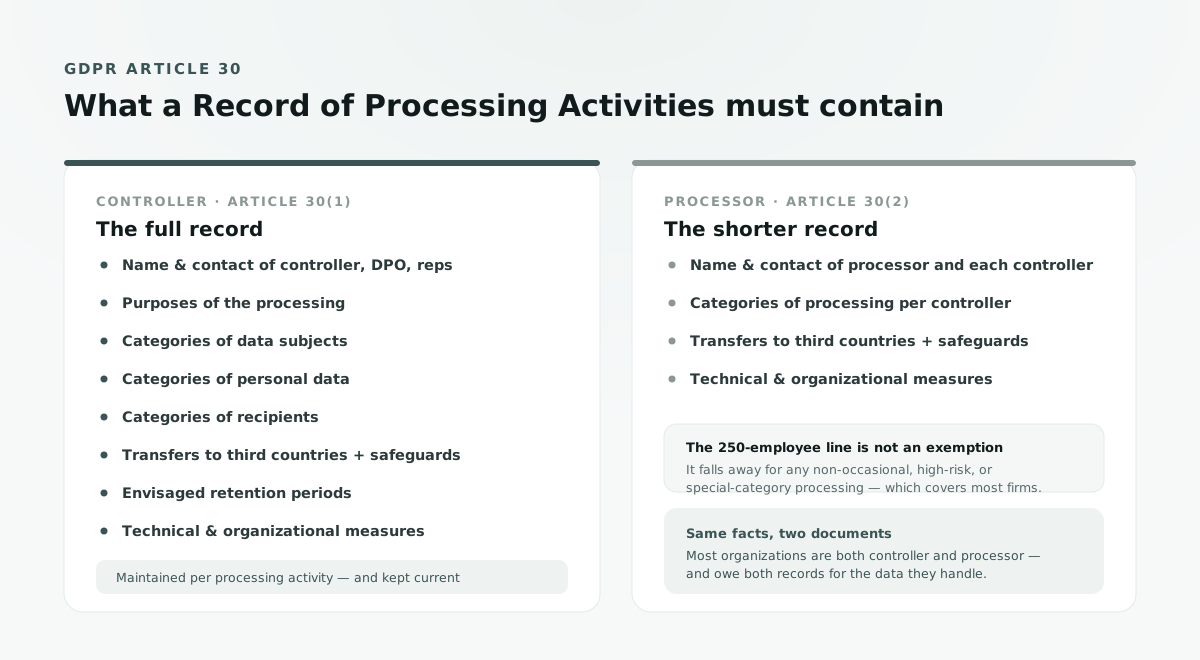
For each processing activity, a controller must record: the name and contact details of the controller (and where relevant, any joint controller, representative, and the Data Protection Officer); the purposes of the processing; a description of the categories of data subjects and the categories of personal data; the categories of recipients the data is disclosed to, including those in other countries; any transfers to a third country and the safeguards relied on; where possible, the envisaged retention periods; and, where possible, a general description of the technical and organizational security measures in place.
The processor's record (Article 30(2))
A processor's record is leaner but no less real: the name and contact details of the processor and of each controller it acts for; the categories of processing carried out on behalf of each controller; any third-country transfers and their safeguards; and, where possible, the same general description of security measures. The shorter list is not a lighter obligation — it is the same accountability seen from the other side of the contract.
Who actually has to keep one
There is a persistent myth that the RoPA is only for large companies. It comes from Article 30(5), which says the obligation does not apply to an organization with fewer than 250 employees. Read one sentence further and the exemption almost entirely dissolves. It falls away if the processing is likely to result in a risk to people's rights and freedoms, if it is not occasional, or if it includes special categories of data or data about criminal convictions.
Any company that processes customer or employee data on an ongoing basis is, by definition, not processing "occasionally." The practical effect is that the small-business carve-out covers almost no one running real software. If you handle personal data routinely — and any product or payroll does — assume you need a RoPA, regardless of headcount.
Why the RoPA is uniquely hard to keep honest
Most privacy documents describe intentions: a policy says what you intend to do, a notice tells people what you intend to collect. The RoPA is different. It claims to describe a fact — what your systems are doing with personal data — and facts about software change with every deployment. That is what makes the RoPA the hardest privacy document to keep true, and the easiest to be caught out on.
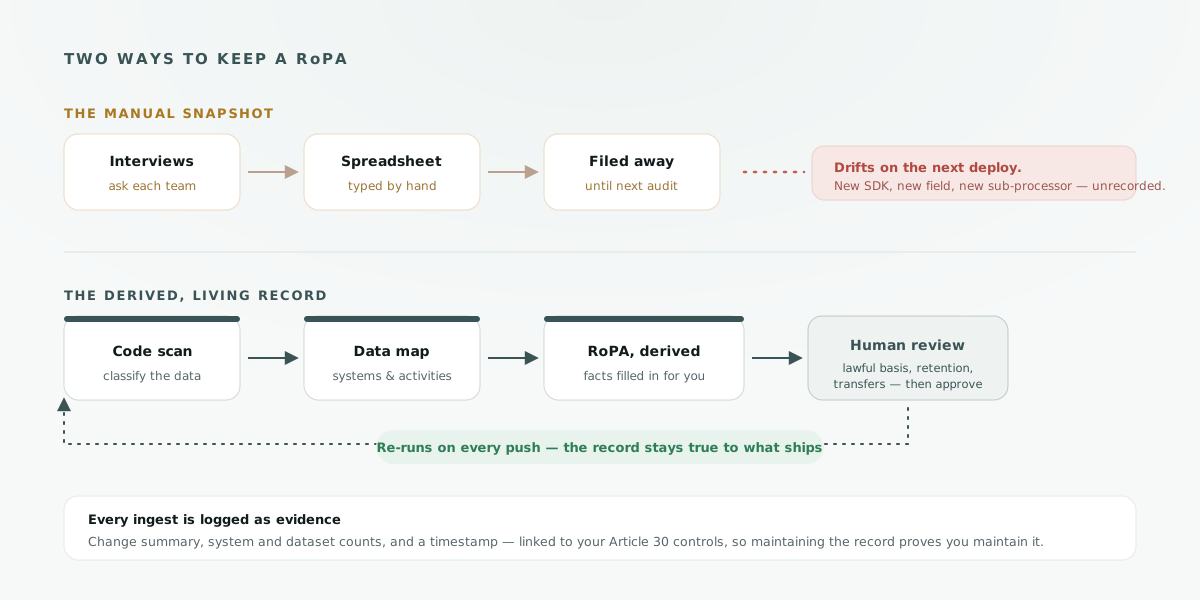
The conventional way to build one makes the problem worse. A privacy manager interviews each team, asks what data they collect and why, types the answers into a spreadsheet, and files it. The record is accurate the day it is written. Then a sprint adds an analytics SDK, a new field starts capturing a date of birth, a vendor is swapped for another in a different country — and none of it reaches the spreadsheet, because nobody thought to send another questionnaire.
We see the same failure modes in nearly every manual program, and they are worth naming because automation is really about designing them out:
- It is a snapshot, not a system. The record reflects one moment of interviewing, then drifts further from reality with every release that follows.
- It asks people questions they cannot answer precisely. "Exactly what personal data does this service process, and where does it flow?" is genuinely hard to answer from memory across a large codebase.
- It documents belief, not behavior. Without visibility into the code, the privacy team is recording what engineers think the system does — not what it actually does.
- Sub-processors and transfers slip through. A vendor change or a new region is a contract event, not a code review, so the recipient and third-country fields quietly go stale.
- Audit prep becomes archaeology. When a regulator asks, the record has to be reconstructed and re-verified by hand, because it was never produced as a byproduct of the work.
A better model: derive the record, don't author it
If the RoPA is fundamentally a description of what software does with personal data, then the most reliable place to build it is the software itself — not a meeting about the software. This is the shift from authoring a record to deriving one: instead of asking people to remember and transcribe, you read the code, identify where personal data enters and flows, and let the record assemble itself from that ground truth.
The key to making that portable is describing data once, in a shared vocabulary. Noru classifies scanned data against an open privacy taxonomy standard maintained by the IAB Tech Lab (the IAB Tech Lab privacy standards), which describes data along three axes — what the data is, why it is processed, and whose data it is. Because the same classification powers a European Article 30 record, a US state assessment, and a vendor review, you describe a field once and satisfy many regimes from it. We go deeper on the scanning approach in our companion guide to privacy automation (our privacy automation guide).
How Noru builds and maintains your RoPA
Noru treats the RoPA as a product of a living data map rather than a document someone keeps editing. A scan of your source code produces a structured map of systems, datasets, and processing activities; the Record of Processing Activities is generated from that map and kept in step with it.
The technical fields fill themselves
The facts Article 30 asks for that can be read from the system are read from the system. Purposes, categories of personal data, categories of data subjects, recipients, and the special-category and cross-border flags are derived directly from the scanned activities. The fields most likely to drift in a manual record — the ones tied to what the code actually does — are exactly the ones the scan keeps current.
Judgement stays with people
Some entries in a RoPA are not facts about code; they are decisions. The lawful basis for a processing activity, the retention rule, the specific transfer safeguard relied on — these carry legal weight and belong to accountable people. Noru leaves these for human authorship and tracks each entry through a clear status as it moves from derived, to in-review, to approved. AI can remove the blank page — drafting a proposed lawful basis with a short rationale and a plain-language purpose statement, each with a confidence score — but nothing is applied silently. Every suggestion is a draft a person accepts, edits, or rejects, and the choice is recorded.
It stays current, and proves it
Wire the scan into your pipeline and the map refreshes as the code changes, so the RoPA reflects what you ship rather than what someone remembered. Each source carries a version history showing exactly what changed on every push, and every ingest is recorded as an evidence item — a change summary, the counts of systems, datasets, and activities, and a timestamp — linked to your Article 30 controls. The act of keeping the record current quietly produces the audit trail that demonstrates you keep it current.
One record, every jurisdiction
The RoPA is a GDPR construct, but the work behind it is not wasted anywhere else. Because the underlying data is classified once in a shared taxonomy, the same map that produces your Article 30 record also answers the equivalent duties elsewhere — the inventories and data protection assessments expected under a fast-growing patchwork of US state laws and other regimes. Noru reads the signals in your activities, such as special-category data, cross-border transfers, sale or sharing, and profiling, and maps them to the regimes they trigger, so one map serves every applicable jurisdiction at once.
It is worth being honest about the boundary here. Automation does not make the legal decisions, and it should not pretend to. The right framing is augmentation: the machine discovers the data, keeps the map in sync with what ships, and drafts a credible first version; the experts review, decide, and own the outcome. The same line runs through how we think about consent — a banner records the question, but only continuous monitoring proves you honored the answer, a theme we explore separately (continuous consent monitoring).
A Record of Processing Activities should not be the document you dread before an audit. Noru turns it into a byproduct of shipping software — derived from your code, kept current on every push, reviewed by the people accountable for it, and ready for any regulator who asks. If you want to see what that looks like against your own systems, you can explore it at noru.tech.